
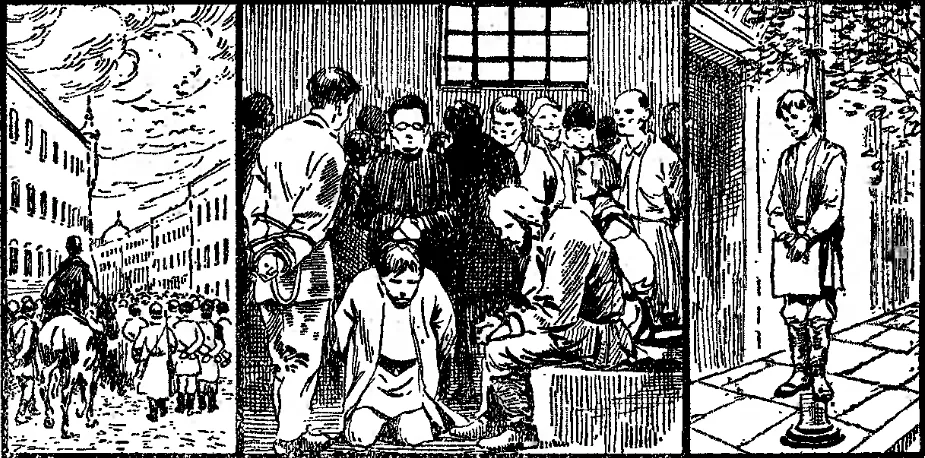
There is perhaps no better resource to learn about the individual hardships that Lemko-Rusyns endured during the years between 1914-1918 than the Thalerhof Almanac. A four-volume collection by the Lviv Thalerhof Committee, it was the first attempt to provide a historical description of the Austrian terror against the populace of Lemkovyna, Galicia, and Bukovina from the killings at the outset of WWI to the concentration camps of Thalerhof and Terezin.
Until now, this foundational text has been largely inaccessible to the English-speaking world, and the crimes and victims described within it have been lost from the historical consciousness of Central Europe except among the people of Carpathian Rus. There are many reasons one can give as to why, most of them involving issues of suppression, national identity, and political incentives. Even today there are some, perhaps a large nation to the east, that would prefer to not have the crimes of their “activists” be brought to light. Unfortunately for them, this obscurity will itself soon disappear. After over two years and hundreds of hours of work, this new series of translated excerpts from the Almanac is ready to be released.
The text below is a section from the latter half of the first volume dealing with the onset of the Austrian Terror against the Lemko-Rusyn population. It covers, in particular, the martyrdom of Saint Maksym of Gorlice, the journeys of the first arrivals to Thalerhof, and a glimpse into the final moments of a dying old world. Over the coming months, more of the most interesting sections of the Almanac will be published, with the entire volumes eventually being available to read.
Старiк Поллок
Founder, The Society for Rusyn Evolution
* * *
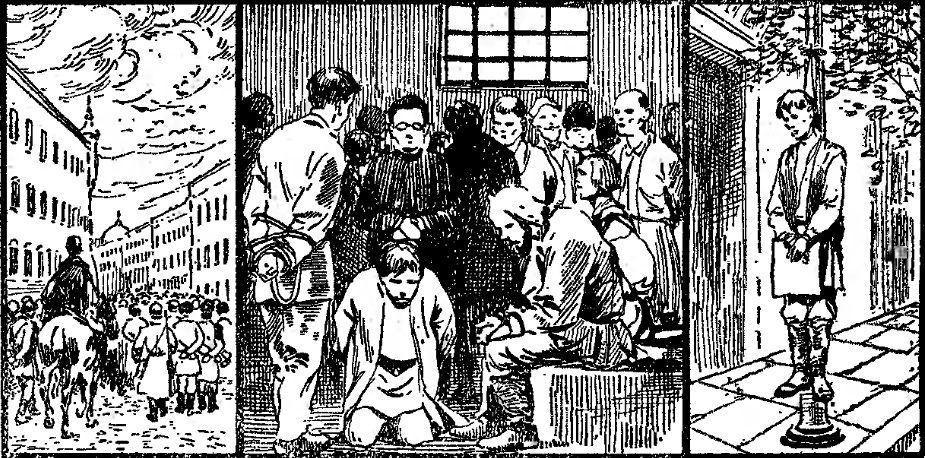
LEMKOVYNA
Gorlice County
(From the Notes of Fr. Vasyliy Th. Kuryllo)
Searches and arrests in Gorlice were quite energetic and vast due to the particular zealousness of the local starosta [county captain] Mitshko.
To begin with, as early as July 31, 1914, a search was conducted on the premises of Ruska Bursa in Gorlice and in the private apartment of its Head, Damyan Bubnyak; they took away some Russian books (the works of classic Russian writers) as well as several .22 CB Caps, which were found among the things that a certain Mrs. Banytskaya had left for storage in the dormitory and that had belonged to her late husband. The latter fact also gave rise to absurd rumors, as if bombs and so on were found in the dormitory. Besides that, the dormitory was searched two more times; another search was done at the credit society Lemkovskaya Kassa, where nonetheless no “dangerous” things were found. Still, a permanent police guard was set up at the building of the dormitory.
The head of the dormitory, D. Bubnyak, was then twice summoned to the county office for the completion of a search report and to provide explanations about the searches, after which he was told that he was not to leave his apartment. On his way back from the county office, he encountered his fellow villagers who were heading off to the army, spoke with them and saw them off to the station—and was then promptly arrested by a gendarme in earnest and taken to the county court prison. This happened on August 1, and was the first case of military prison “mobilization” in the county of Gorlice.
Meanwhile, more and more absurd and sensational rumors started spreading throughout the town, which must have been aimed at preparing the public opinion to the forthcoming arrests of the “Russophiles”, and set the opinion accordingly. Thus, besides the rumor about the bomb in the dormitory, a hoax claiming that “Russophiles”—Fr. V. Kuryllo from Florynka (former chairman of the same Ruska Bursa) and Fr. G. Gnatyshak from Krynica—were caught red-handed while they were trying to blow up the railway bridge in Muszyna and were shot on the spot. An equally false report was made in the Gorlice county office which stated as if Fr. Kuryllo came to Gorlice and was staying at Bayla’s Inn, in view of which two gendarmes were sent there to seize him, but didn’t find him, for the simple reason that he was in Lviv attending to some family business at the time.
Later, full-scale arrests began both in the city itself and the county. Thus, on August 3, Dr. Dym. Sobin, an assistant to a barrister, O. Slyusar, accountant of Lemkovskaya Kassa and secretary of Ruska Bursa, and a student named Th. V. Kuryllo were arrested in the city.
The next day, on August 4, two students from the dormitory, Al. Telekh and Nyk. Gal from the village Losya, were brought to prison; some of their textbooks and their tobacco was taken away from them. Later on the same day the following people were brought from the same county: Fr. Theodosius Durkot from Zdynia, an Orthodox priest, Fr. Maksym Sandovich and his father Timofey, a peasant from Zdynia and two students, Ivan Yadlovskiy from Smerekowiec and Ivan Vyslotskiy from Gladyshiv [Gładyszów]. At the same time, an old postmaster Baissa and a student named D.I. Kachor (who was here on his way from Lviv to his village of Bodaki) were arrested in the town.
On August 6, the following persons were arrested and brought to Gorlice: a clerk of Lemkovskaya Kassa and the volost Iosafat Krylevskiy, wojt Petr Korba from Leszczyna, dormitory student Al. Dudka and Ivan Labovskiy from Bielanka, a gymnasium graduate Theodosiy Yadlovskiy (the student’s brother) from Smerekowiec (whose books by Gogol and a few issues of Novoye Vremya were taken away) and peasants K. Dutkanich from Bortne and Th. Zhurav from Banica. At the same time, a Pole who was a teacher at the College of Commerce in Tarnów, Iosif Kopystinskiy, was arrested by mistake, as he couldn’t produce his identification; he was nonetheless bailed out a few hours later.
On August 8, Thoma Necio, a peasant from Bortne, was arrested along with a teacher Tyt Bogachik, who was arrested in Biecz and detained in a prison in Jasło.
In the morning on August 10, Andrey Karel, a law graduate from Losya, was brought to prison.
On August 12, Fr. Maksym Sandovich’s wife, Pelageya Ivanovna, was arrested in Zdynia; she was not, however, transferred to Gorlice but was interned for the time being in the wojt’s house in Rzepiennik, where she was detained for nine days. At the same time Mikhail Sobyn, an innkeeper from Bortne, and a peasant, Vas. Kulyk from Russka Ropica [Ropica Gorna] were arrested.
On August 13, a gymnasium student Thedor Voytovich from Ruske Uscie [Uscie Gorlickie], a fun-loving and lively young man, who entertained and supported all the prisoners with his witty jokes and singing, was cruelly chained some time later and taken to Nowy Sącz in time for the military draft and sent into the army. On the same date, Thedor and Kosma Gorbal from Bortne were arrested (both later died in Thalerhof).
On August 20, Petr Kozak from Russka Ropica was arrested.
On August 21, P.I. Sandovich was transferred from Rzepiennik to the prison in Gorlice where she was first detained on the ground floor, together with Gypsies, and was later taken to a small filthy cell on the first floor.
On August 22, Thedor Bayus from Malastow and a number of other peasants were brought to the prison.
On August 27, Yuriy Dzyamba from Lug and Andrey Vasicek and Andrey Lukachik from Smerekowiec were brought.
On August 29, Yakov Vislotskiy (a student’s father) and Mikhail Syrotyak from Gladyshiv were brought.
On August 30, Th. V. Kuryllo, a student who had already been detained for four weeks, was transferred, for having spoken disparagingly of the prison food in a letter to his brother, to a damp, dark, and dirty cell on the lower floor where as many as 30 people—mostly criminals and a few peasants—were already so confined to the point that there was no space to move. Furthermore, the terrible stuffiness and stench of human perspiration, tobacco smoke, and a permanently open latrine, made staying in this cell utterly unbearable. They slept in a heap on rotten straw infested with fleas and lice. Here, Th. V. Kuryllo spent three days, after which he was transferred back to his previous cell on the first floor.
On September 3, a gymnasium graduate now studying in a dormitory, Simeon Pyzh, and Wapienne wojt Vasyliy Bubnyak were arrested. At the same time, two “Ukrainian” priests who had run away from Eastern Galicia were seized together with their families, and became quite indignant at the misunderstanding, saying they were not some “Moscowphiles” but “true Ukrainians”. On the same day, gendarmes brought a volost clerk from Lipna, Ivan Pelesh, shackled; during his interrogation he bravely claimed he was Russian and Orthodox.
On September 5, a 77-year-old Matvey Tsupura was brought from Mecina Wielka. On the same afternoon a special division of sixty German gendarmes commissioned for punitive expeditions in the county arrived from Salzburg to Gorlice.
On September 6, at 6 am, Fr. Maksym Sandovich, an Orthodox priest from Zdynia, was shot in the town square in front of the courthouse, with his father and wife looking from the prison windows; he was shot without any trial and investigation, on a single order by a certain captain Dietrich from Linz2.
On the same day, a retired teacher from Zdynia, Simeon Usitskiy, was arrested and first taken to Jasło, then Wadowice, and from there interned directly to Thalerhof.
On September 7, Emilian Hryvna, a teacher from Czarny, was brought to the Gorlice prison.
On September 12, the following people were brought: peasant Thedor Hryvna from Malastow (the teacher’s father), who had to leave three little children behind without any care (he later died of typhus in Thalerhof), then gymnasium student Dionysiy Pototskiy, teacher Aleks. Vyslotskiy, peasants Nykolay Sandovich (Fr. Maksym’s brother), Dmytriy and Kondrat Spyak and Thedor Shevchik (all from Zdynia), Vasyliy Bubnyak, Konst. Bodak, Ivan Vantsa, Petr Tylyavskiy, Yuriy Dragan, Konst. Kotsur and Andrey Pyzh (all from Rozdzelie), Danko Prokopchak, Mikhail Pyzh, Aleksey Timots, Thedor Prystash, Ivan Bodak and Dmytriy Bubnyak (all from Wapienne), teacher Ivan Bogachik from Bortne (whose three sons were serving in the Austrian army), and finally in the evening, a gymnasium student Nykolay Yurkovskiy from Radocyna.
In the evening of September 13, Fr. Vladimir Kaluzhnyatskiy and three peasants from Bortne as well as Fr. Stepan Volyanskiy, Semen Stanchak and a few other peasants from Smerekowiec were also brought in.
Finally, on September 14, the following people were brought: Fr. Grygoriy Kalynovich, peasants Athanasiy Andreychik and Andrey Tsislyak and two women from Ruske Uscie (the latter were nonetheless immediately released by the court investigator Kalchynskiy), Maksym Karpyak, Vasyliy Bazylevich, Dmytriy and Iosif Demchaks, Grygoriy Decio, Kondrat Khomiak and Pavel Barna from Klimkivka, A. Kraynyak from Skwirtne, student of Kraków Academy of Arts Mikhail Fedorko from Gladyshiv, and finally thirty peasants from Losya, namely: Iosafat and Vasyliy Krols, Stepan Pavlyak, Grygoriy Paranich, Grygoriy Shlyanta, Yakym and Grygoriy Dudras, Aleksandr and Mikhail Telekhs, Pavel Karel, Ivan Fekula, Grygoriy, Nykolay and Ivan Spolnyks, Ivan Novak, Theodor Maletsky, Ivan, Grygoriy and Mikhail Gals, Mikhail Dudyk, Pavel and Nikolay Gorniks, Grygoriy Trembach, Simeon Dudka, Ivan Oleshnevich, Ivan Palyukh, Ivan Kondratik, Daniyl Khoma, Nykolay Yevusyak and a Gypsy named Yakov Syvak.
It should be noted that the aforementioned peasants from Losya were not arrested at their homes nor were any searches carried out; instead, simply for convenience, they were summoned to the volost [township] office as if for a meeting, and were then put onto horse carts and taken to prison.
These are all the important facts about the arrests of the Russian people in Gorlice County carried out by the Austrians at the beginning of the war, which were established and checked.
As we can see, they grabbed everyone indiscriminately: first, of course, practically all the intelligentsia—priests, officials, teachers, lawyers, students, even young gymnasium pupils—then the more conscious and active peasants, not excluding township elders (wojts), clerks and deacons, and even women and children.
Apart from the starosta Mitshko, most of the instigators hunting down these unfortunate “Russophiles” were gendarmes (mostly of Russian descent) Kogut, Grytsak, Nezgoda, Gergelevich, Svobodzyan and others. They were aided in their Cainous [fratricidal] work by some renegades of the “Ukrainian” persuasion, themselves Russian, such as public school teachers Kobaniy from Gladyshiv, Pereyma from Russka Ropica, priests Mentsinskiy from Malastow, Podliashevskiy from Gladyshiv, Zayats from Mecina Wielka, Govda from Bodnarka and others through the most absurd and false denunciations and rabid hounding. Furthermore, some Jews were also quite zealous in this regard.
The arrested were treated very poorly in the prison, sometimes even worse than the Gypsies and other criminals under investigation, although the prison warden, the old Nozhynskiy, personally treated them quite politely and humanely.
Extremely hostile and rude toward the arrested Russians were those who were in charge of them—court councilor Kalchynskiy and prison doctor Dr. Przhesmytskiy—who, incidentally, were the primary leaders of the chauvinist Polish politics in the county.
The food in the prison was terrible. The watery soup was usually seasoned with various insects or hair. Meat was only given once a week. Any complaints about the food only brought disciplinary punishments, as was already noted above, for example, with Th. V. Kuryllo, or as happened with one Gypsy detainee from Moravia who was put in shackles for a week for a similar complaint.
People slept on hard mattresses filled with wood chippings or rotten straw with all sorts of parasites. Light was not allowed in the evenings. Water was given three times a day—stinky, with filthy residue. Smoking was prohibited.
The Russian sufferers remained in the Gorlice prison in these terrible conditions until September 14, when they were taken further west in view of the unstable positions of the Austrian front. The day before, on September 13, councilor Kalchynskiy told them to get ready to leave and transferred all the educated people into one large cell on the ground floor. But they started only on the evening of September 14; and what is more, they were accompanied to the railway station by swearing and threats of a huge crowd of local Poles and Jews. At the train station everyone boarded dirty cattle cars, where horses had been kept; only Pelageya Ivanovna Sandovich, who had refused the freedom offered to her by councilor Kalchynskiy after her husband’s execution and opted for following her family and countrymen into exile, was put separately, in a third class passenger car together with her father and her husband’s brother.
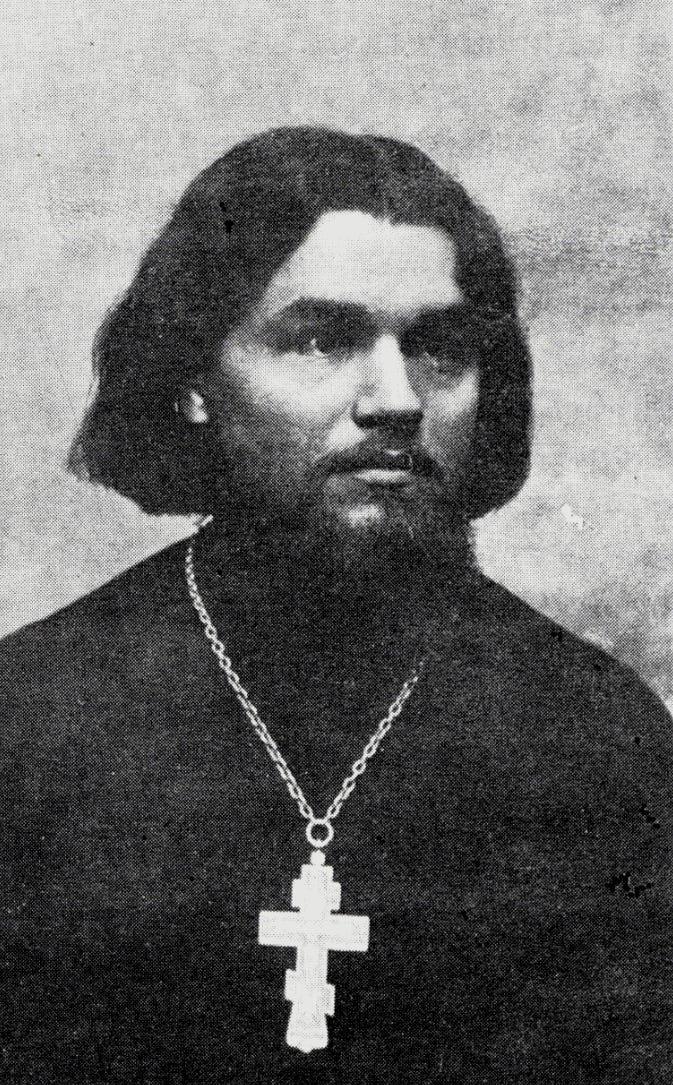
The whole transport was aimed for Thalerhof; only a number of people were for some reason taken separately by gendarmes before the military court in Kraków.
Two days later, on September 16, another transport was assembled from those still remaining in the Gorlice prison and those newly arrested (120 people in total), and was sent to Thalerhof that same day.
* * *
In the county of Gorlice, a prominent Russian activist and leader Father Mikhail Yurchakevich from Czarny was also arrested and later even brought before a military court on charges of state treason; however, regrettably, no further details about this have been received by the editors to date.
The Execution of Maksym Sandovich
We all remember the remarkable political trial against S. Yu. Bendasyuk and his comrades before the war, where one of the defendants was an Orthodox priest from Zdynia, Fr. Maksym Timofeyevich Sandovich. It is common knowledge that after the end of the trial and the jury’s unanimous acquittal, the attitude in senior government circles towards the actors of the trial was so aggravated that it became clear that not only the defendants but also the defense lawyers and affiants could do nothing better than try to escape new administrative persecution by getting away from the reach of the Austrian gendarmes. That is exactly what most of them did; they took advantage of the initial bafflement of the Austrian authorities after the trial and left—some for Switzerland, some for Russia.
Father Maksym Sandovich did not think to do this, however. Trusting too much in the legal power of the acquittal, he hurried to return to his village after two and a half years in prison, to his beloved family and parish, where the military mobilization announced in July 1914 and the following wave of terrible Austrian atrocities and terror caught him, and where he himself was fated to be one of the first to fall victim to this awful bloody wave…
On August 4, not only he, but also his father, a peasant from Zdynia, were arrested and imprisoned in Gorlice. Hardly a week had passed when the priest’s brother and his wife, Pelageya Ivanovna, were also arrested. The latter, however, was not taken to the Gorlice prison immediately, but to Rzepiennik nearby Biecz and detained in the local wojt’s house. After nine days, she too was transferred to Gorlice.
Fr. Maksym Sandovich stayed in prison without being interrogated or investigated until September 6, when the prison warden Nozhynskiy suddenly entered his cell at five in the morning and told him to get ready to go. The warden meanwhile took the priest’s wife and father out of their cells as if “for a walk” but in fact in order to take them to a cell overlooking the square. Having locked them both in there, he then left them alone.
Meanwhile, representatives of the local authorities started gathering in front of Fr. Maksym’s cell. Namely, Captain Dietrich from Linz, Court Councilor Kalchynskiy, four gendarmes and two soldiers with a sergeant major, after which, at six in the morning, the prison warden Nozhynskiy entered the cell again and ordered that Fr. Maksym follow him; but when the latter wanted to take his belongings as well, he was ordered to leave them where they were. Then, according to the words of a gymnasium student Al. Telekh, who was also detained in the prison, they tied Fr. Maksym’s hands behind his back and blindfolded him with a towel, after which two soldiers seized his arms, took him outside into the square in front of the prison and put him in front of the brick wall. Two gendarmes were standing four steps in front of him with their guns loaded, Captain Dietrich and the Wachkommandant [Guard Commander] were standing to the side, and a huge crowd of onlookers gathered in the square. The Commander thought that Fr. Maksym, who bent slightly left, was going to fall, he shouted “Halt!” at him. Fr. Maksym, who already realized he was to be shot, stood up straight and said distinctly: “Lord, bless me!” An order was shouted—two bullets pierced Fr. Maksym’s chest. He didn’t fall, however, but only leaned against the wall. In a weakening voice he said: “Long live the Russian people and the holy Orthodox church!” Then the guard commander came up to him, took out his revolver and shot him in the head at point blank range. Fr. Maksym fell. The soldiers picked his body up on a sheet and carried it off. In the courthouse, a plain coffin made of wood planks was ready. Two deep holes stained with blood remained after the shooting in the brick wall.
Another witness, K.L. Vanko, a gymnasium student present in the crowd of spectators, gives a recollection of Fr. Maksym’s death with slightly different details. “I had arrived,” he said, “in Gorlice to deliver the money to the prison administration for my arrested father. On Sunday, September 6, at seven in the morning, unusual commotion in the streets caught my attention. A large crowd of people was gathering around the courthouse and the prison nearby waiting for something. There were not only men, but also women and young people, all of them very nervous. I listened to the talks and to my greatest surprise and horror I learnt that a “Moscow priest from Zdynia” was going to be executed. My heart sank but I decided to stay and witness Father Maksym’s martyrdom. There was a group of officials and gendarmes in front of the courthouse. After a few minutes of agonizing expectation that seemed to last an eternity, Fr. Maksym was taken out of prison. He walked to meet his death as a martyr with dignity. He was wearing a cassock; only the pectoral cross was taken off him. He was put by the wall and the starosta Mitshko read the sentence, from which I only remember that the execution was carried out not on a court verdict but on the order of the military authorities. After this peculiar sentence was read, one of the gendarmes came up to Fr. Maksym to tie his hands, but Fr. Maksym asked him not to do it. Then the gendarme blindfolded him and made a small sign on his chest with a piece of chalk. A few meters away from Fr. Maksym, a gendarme, one from the Tyrolean shooters, was standing. An order: one, two, three! A shot rang out. Fr. Maksym shuddered and having collected whatever strength he had left uttered in a weak voice “Long live the Russian people and the holy Orthodox church!” His head fell onto his chest, he leaned against the wall with his whole body and in a moment he fell to the ground. Suddenly an agonizing terrible scream and heartbreaking weeping escaped the walls of the prison. It was Fr. Maksym’s wife, Pelageya Ivanovna, who had witnessed her husband’s death from the prison window, collapsed unconscious and the prison filled with the wails of the poor woman. More sobbing could still be heard. Everyone saw a tall figure of a gray-bearded old man in another barred window. It was the father of the executed, Tymofey Lukich Sandovich, who was also imprisoned and saw the sacrificial death of his son. Meanwhile, all the officials, gendarmes and a few people from the crowd came up to the fallen man. I couldn’t brace myself and come up and have a look, I only wanted to escape the terrible place as soon as possible. Suddenly, another shot rang. It came from a gendarme who shot Fr. Maksym again by putting the revolver right to his head. After the execution I learnt from one credible official that Fr. Maksym had been executed without a trial. On the night of September 5, at eleven at night, an order to shoot him came from the Kraków corps command, of which he was immediately notified. He asked for permission to write a letter to his wife, who was at the same prison, in the cell next door. He was granted it. But when he asked for permission to say goodbye to his wife and his father in person, he was denied. (“Prikarpatskaya Rus”, 1914, No.1499).
Neither Fr. Kuryllo nor the prison warden Nozhynskiy, who later told other prisoners about the details of the shooting, mentioned that Fr. Maksym had been informed about the upcoming execution.
The shots that rang outside drew some prisoners to the windows.
“Get away from the windows or everyone will be shot!” a gendarme shouted. Only when the body was taken away, a new loud bark came: “Please don’t be afraid, we won’t shoot, we only want to announce the verdict.” Immediately, a few prisoners—and a bit later, all of them—showed up at the windows, and the guard commander served as an interpreter and read out the “verdict” rendered by Captain Dietrich: “Pan rotmistrz zazadal wydania Maksymowicza i ten zostal zastrzelony na jego odpowieszialnosc. Jesliby kto cos podobnego zrobil, co on, to bedzie zastrzelony.” [The captain demanded that Maksymovich (instead of Sandovich) be handed over to him, and he was shot on his responsibility. Should anyone do what he did, they will be shot.] The fact that Fr. Maksym was indeed shot on the single-handed order of Captain Dietrich was also confirmed by warden Nozhynskiy to the father of the deceased, saying after the execution anxiously: “It was all done by that officer; he is like that—life or death…”
This lawless execution clearly made a terrible impression on the more impressionable prisoners. Some of them suffered from nervous breakdown so much that any sound or whisper made them fear and shiver; some could not sleep for a few nights in a row or jumped up from their beds in an urge to run.
The place of execution remained attractive for the vain town crowd, which studied the traces of bullets and blood stains on the wall with spiteful comments and smiles or listened to the stories and jokes of the eyewitnesses of the execution.
A few days later, councilor Kalchynskiy called Pelageya Ivanovna into his office and offered to release her; however, the exhausted and much-suffering woman chose to stay in prison with her husband’s relatives rather than be subject to new dangerous and persecution in this Austrian “freedom”, and was therefore later, on September 14, sent off to Thalerhof along with her husband’s father and brother as part of the first internee transport from Gorlice.
Grybów County
(based on the notes of Fr. Vasyliy Th. Kuryllo)
It seems that in no other county in Galicia did a dying Austria have as many invited and uninvited informers and provocateurs as in this county. The place swarmed with them—among the various village officials and henchmen, among the people, most of whom came from Eastern Galicia, the teaching profession, and even, regrettably, among the clergy. And although the county authorities, who had until then treated the local Russian leaders quite politely in general, who even knew some of them quite well and did not pay much attention to the multiple denunciations that were abundant ever since the start of the war, and in some cases even reacted with sanctions against the instigators and authors, with time, when all power naturally passed into the hands of the military commandants, the latter had their wicked effect all the more successfully and became the cause of much severe suffering and bloody victims among the local Russian population.
As it has already been mentioned in the account of events that happened in the county of Gorlice, no later than July 31 someone started false rumors about me in Gorlice (where I was known as a former chairman of Ruska Bursa, and one of the local people’s leaders in general) that I was arrested and shot along with Fr. G. Gnatyshak from Krynica for allegedly trying to blow up a railway bridge in Muszyna while disguised as Jews, or that I secretly came to campaign in Gorlice which made gendarmes hunt for me in Bayla’s inn and other places the same night. But all this was simply absurd and malevolent nonsense as I was taking my daughter Aleksandra to Lviv to join the Red Cross as a nurse at the time. I clearly could not have entered any kind of conflict with the authorities. Only my son Theofil, a student, was arrested in Gorlice on August 3, which we only found out from a postcard sent by him two weeks later.
At my home in the village of Florynka, gendarmes turned up only at the end of August, and this time they limited themselves to a search and drawing up a report. They also asked about my daughter Vladymira, a teacher from Losya, but she was not home, so they left empty-handed.
Later, on August 31, the newly appointed military commissary with the Grybów county office, Mr. Ynes, arrived in our village with 6 gendarmes with the purpose of investigating the authorship and veracity of an anonymous report to the military command in Nowy Sącz alleging that I, Fr. Th. Kachmarchik from Bolcarjova [Binczarowa], Fr. P. Sandovich from Brunary, and Fr. Vl. Mokhnatskiy from Czyrna were “Muscovites” dangerous to the state. As it later turned out, the report written on three large pages peppered with a variety of absurd tales and accusations was made up by a local Pole named M. Pylch on an order of gendarme P. Klyuchnik, a “Ukrainian” also living in Florynka. Therefore, the first thing commissary Ynes did was go to P. Klyuchnik for explanations and then, having established that he was indeed the author of this deceitful and spiteful report, arrested him and sent off to the Grybów prison. However, P. Klyuchnik didn’t stay imprisoned for long. On the order of the military authorities he was released on September 10, and instead they immediately went on to arrest the Russian people in the county. And the first among them, the very same individuals whom he mentioned in his report.
And so, on September 10, Fr. Theofil Kachmarchik from Bolcarjova was arrested. On the 11th—myself, and on the 14th—Fr. Petr Sandovich from Brunary and Fr. Vladymir Mokhnatskiy from Czyrna as well as a large number of peasants. Even before that, on September 5, twenty-three gendarmes arrived in Florynka to conduct investigations and surveillance, and as many as sixty gendarmes came to Snitnytsia [Śnietnica] and remained there until September 9.
My arrest occurred in the following manner: on September 11, at three in the afternoon, a police commissar from Lviv named Kruchek turned up at my house with an agent and a gendarme; and after a fruitless search of my house and the church, he told me the starosta wanted to see me in person immediately to provide explanations about some letter. Believing these words, I started on my way without any of the things I had long prepared to take in case of an arrest, expecting that I would indeed return home after speaking to him. Meanwhile, in Grybów, the commissary didn’t take me to the county office, but straight to prison where he handed me over to the warden and apologized saying he couldn’t have told me about everything back home.
In prison, I saw Father Kachmarchik and his son, a notary assistant, Lubomir, who had been detained for two weeks already. The latter told me that Fr. Dmytriy Khyliak from Izby and a gymnasium student Mikhail Maksymchak from Florynka had been under arrest along with him but had been chained and taken to Kraków.
More arrestees were brought into the prison every day, but they were taken further the next day, only the three of us (Kachmarchik, his son and I) remained for some reason in the same place. Among others on September 14, as was already mentioned above, Fr. Vl. Mokhnatskiy, Fr. P. Sandovich, and many peasants were brought in, and at the entrance to the prison their belongings and bread were taken away from them, and the next day they were marched in pairs to the train station and sent to Nowy Sącz.
But our turn came too. As the Russian troops were rumored to be approaching Tarnów, panic broke out in the town and a hasty evacuation began. Early in the morning of September 23, a gendarme came running to us in the prison and led all the arrestees still remaining in it, twenty people in total, to the train station. There we were hurriedly loaded into a third class car and taken to Nowy Sącz.
The train stopped in the field before Kamionka station, as it was packed with other trains. Other passengers, mostly those in flight, scattered out of their train cars and with the gendarme’s approval surrounded our car with shouts and laughter as if it were a cage in the zoo. However, at first they behaved well. Only when the soldiers guarding the tunnel came up and two of them, “Ukrainian” teachers Shvedik and Merena, shouted “Ah, Moscowphiles! Take them to the hook!” The crowd flamed up and dashed towards us with such a menacing look that our gendarme even had to warn them with a rifle not to come. Nonetheless, vulgar swear words, rude jokes and even bits of dirt and stones showered us from all around and tortured us for three whole hours until the train started again.
In Nowy Sącz, the train also stopped away from the station. Heavily guarded by gendarmes and accompanied by a wild town mob, we were marched on foot to the county court, where we were locked up in the yard as there was no room left in the prison. In the evening they wanted to transfer us into the gendarmerie for the night, but the three of us (Fr. Kachmarchik, his son, and I) were so exhausted and weakened from hunger and anxiety that we could not go any further, and so we persuaded the gendarmes to leave us where we were.
With great difficulty they managed to find a place for us in a cell on the second floor, where we were put for the night with all our money and belongings—from watches to hats—taken away from us. In the cell we saw Fr. Dr. Mastyukh from Przemyśl who had come to Nowy Sącz to substitute for an absent parish rector, but was immediately arrested as politically suspect, and we also saw a catechist from Tarnopol, Fr. Korenets, who had fled with his family from the Russian troops and was arrested at the train station in Nowy Sącz, with his family were left to the mercy of fate with no means.
In the morning we were taken to the courtyard “for a walk”. There we met Fr. Vl. Mokhnatskiy, Fr. P. Sandovich and other acquaintances we knew, but the guards did not allow us to talk to them. Later we were summoned to an office where our belongings and money were given back to us, and we were told to get ready to continue onward; we were also now allowed to hire cabbies at our own expense. Accompanied by gendarmes, we made our way to the train station, but along the way the gendarmes suddenly told us to get off the cart and made us walk to the gendarmerie while our belongings were taken to the train station. While there, we saw our fellow prisoners from Grybów who had spent the night in a cold cellar tied in pairs with rope.
When the commandant saw us, he ordered that shackles be brought and Fr. Kachmarchik and I to be shackled together and the rest of the arrested be tied to us in pairs with rope, and at the very end, L. Th. Kachmarchik separately. The commandant’s daughter slipped a quarter of a bread loaf under our arms, after which, amid the swears and threats of the crowd, we were taken to the train station.
At the train station entrance, a new crowd greeted us with shouting and stones; I was also hit hard on my shoulder with a stone from some Jew. At the door we saw our belongings, which had been delivered by the cabbies, but as neither Fr. Kachmarchik nor I could grab them as we were shackled, our fellow compatriots in misfortune—a lumber mill owner named Staviskiy and a Gypsy named Bekhterovskiy—carried them up into the train car.
However, there was no train for us straight away, so we were taken into some stables where we stood in manure, shackled, exhausted and hungry, until the evening. New harassment and threats began, coming both from the railway workers and the soldiers and officers, but by then we had grown used to this treatment to the point where we barely took any notice. Even the guard commandant let himself threaten and mock us, when he returned drunk from the town.
Late at night we were taken back to the station and loaded onto dirty cattle cars. At every station, the drunk commandant advertised us to the passers-by as “Moscowphile traitors” so that we saw no end to the harassment and threats. But fortunately some time later he was overcome by a sense of tiredness and fell asleep on the overcoats on the floor.
Along the way, the peasants secretly took off the ropes that were tying them together, and after that our shackles were taken off the two of us as well.
So we reached Biala. Here we were told to get off and were taken on foot through Bielsk to the county court, where ten of us, including myself and Fr. Kachmarchik and his son were left; the other 10 peasants were taken to the police station for the night. The latter, as my parishioner Yustyn Vorgach later recounted, were summoned in the middle of night to the administration office one by one and under the threat of being immediately shot, were interrogated about Fr. Kachmarchik and myself—whether we received rubles and gave them out to peasants, what we preached and so on. Meanwhile we remained in the prison and were placed in some terribly filthy cell, but no sooner had we fallen asleep than we were ordered to get ready again and go to the prison office where the gendarme Bats (of Russian origin himself) handcuffed us again and took us outside to a car waiting in the street. He also ordered that we leave our belongings behind. When the people standing nearby the car asked him where he was taking us, he only pointed at his neck and lifted his arm as if hanging us.
We drove very fast, about 80 km/h, and only frequent patrols delayed us. It was very cold, so much so that I almost froze wearing only light clothes. Moreover, I couldn’t hide my shackled hands. In the morning we persuaded the gendarme to take the shackles off, as we could not escape away, but as soon as he did so, I heard a terrible cracking and rattle as if from cannon fire. I felt terrible pain in one of my temples and fainted. When I regained consciousness, the gendarme was standing over me, shaking my body with all his might in an effort to bring me to my senses. It turned out that our car had crashed at full speed and only a miracle had kept us all alive. It happened on September 26 in the Gruszowiec village nearby Limanowa. Leaving the wrecked car in the care of the local wojt, the gendarme sat together with us on a passing cart and together we went on. Along the way we encountered a group of Polish legionnaires, which worried us greatly as they had developed a bad reputation, but fortunately, everything turned out well.
In Limanowa we got into another car and the same gendarme, Bats, drove us to Nowy Sącz. But here we were delayed again due to a burst tire, which resulted in the gendarme taking us to the prison on foot. But they were not ready for us when we arrived, so the gendarme left our belongings in the corridor and took us into the courtroom—straight into the hall where the reading of the case against Fr. P. Sandovich and his son and Fr. Vl. Mokhnatskiy was just beginning. The three of us, that is, Fr. Th. Kachmarchik, his son Lyubomir and I, were now joined to the case.
After the court proceedings ended on the evening of September 27, we were all taken back to prison; Fr. Kachmarchik, his son and I were detained together, along with eight more arrested from Ciężkowice and Bobowa. Here we spent several agonizing days dwelling on random guesses and rumors, as we knew nothing about the verdict.
It was on the third day of October when we were transferred to a different cell where Fr. Vl. Mokhnatskiy, Fr. Em. Vengrinovich, Fr. Sobolevskiy, Fr. Dionysiy Mokhnatskiy and others were also detained, when we learned of the terrible news that Father Petr Sandovich and his young son had been shot…
Finally, on October 6, we were ordered to grab our things and all but four people were taken to a market, where we were joined by another group of arrestees brought by the police. Then, in groups of four, we were taken on foot to the train station, which we barely reached at dawn. There were a few women among us, including two daughters of Fr. Em. Vengrinovich and Fr. Sobolevskiy’s wife. At the train station Red Cross nurses gave them each a glass of tea; the men got nothing.
In the morning the train finally came, however it only had one third-class car. The others were dirty heated freight cars, so the over 250 people in our transport had to accommodate themselves where and how they could. In addition to that, it became quite cold and started snowing, but most of us didn’t have any warm clothes and had no choice but to suffer greatly—from fatigue, hunger, and the cold. To make matters worse, unbearable encounters with the hostile crowds of civilians and soldiers, who swore at us and harassed us, began right from the first station.
Only from the stop at Mszana station, where our guards changed, did it become somewhat better. Here we were allowed to bring in a few benches, and later the gendarmes even bought some straw for the women with their money for bedding. They also started to feed us a little, although mostly with soup and tea, and even bought us special food with our money.
We passed through Hungary and Komorno, Trencin, Pressburg [now Bratislava]. At this last station an express train nearly crashed into us but the train driver timely moved our train back and thus saved it from an inevitable crash.
Of other incidents along the way, two particularly characteristic episodes should also be mentioned:
Dr. Simeon Brys, a rabbi from Warsaw, was also being sent into exile with us. Along the way, the gendarmes that were guarding us kept asking him to point at one of our priests and claim he knew him as a traitor and a spy; and promised him freedom in return. But the honest and clever Jew wriggled his way out by saying ”I don’t know any of these people; I knew one, but he is no longer among the living.”
The other incident occurred at the station in Graz. We had to stay at the station for a particularly long time because, as we found out later, some local Duchess had expressed a wish to look at the “traitors”, and therefore our train was not permitted to leave the town until she came.
We experienced much anxiety and distress on the journey on account of a severe nervous breakdown in one of our fellow brethren, Fr. Dr. M. He had been awfully anxious and distraught in prison (often to the point of weeping), and at some point on the train he completely lost self-control. He arrived at our destination in an extremely grave condition.
Finally, on the morning of October 11, they brought us to Abtissendorf, and from there, ushered by the vilest profanity and rifle butts, we were driven on foot to the memorable place of our detention—the terrible Thalerhof.
Priest Vasyliy Kuryllo
The Bloody Trial
(based on the notes of Fr. V. Th. Kuryllo)
On Saturday, September 26, 1914, in the court building in Nowy Sącz, a horrible trial accusing seven local Russian activists of treason was heard before the military court of the local branch of the Kraków military command (Expositur des Gerichtes des K. u K. Militarkommandos in Krakau). The abovementioned military court consisted of the following people: Chairman Major Viktor Polli, Major Auditor Dr. Mechislav Belskiy, State Prosecutor Oberleutnant Auditor Iosif Vondrach, Clerk Lieutenant Ioann Dusha, and Defense Counsel Oberleutnant Auditor Yulian Fulyaita.
The trial persecuted the following leaders of Lemko Rus [Lemkovyna]:
- Fr. Theofil Thomich Kachmarchik, parish priest in Bolcarjova, Grybów County, 71 years old
- his son Vladymir Theofilovich, a student at a university, 22 years old
- his other son Lyubomir Theofilovich, notary assistant from Snyatyn, 36 years old
- Fr. Vasyliy Theodorovich Kuryllo, parish priest in Florynka, Grybów County, 53 years old
- Fr. Vladymir Osypovich Mokhnatskiy, parish priest in Czyrna, Grybów County, 44 years old;
- Fr. Petr Vasylievich Sandovich, parish priest in Brunary, Grybów County, 56 years old
- his son Anton Petrovich, a graduate of Faculty of Philosophy in Lviv, 27 years old
The morning part of the trial proceedings, until midday, was held without three of the defendants: Fr. Th. Th. Kachmarchik, L. Th. Kachmarchik, and Fr. V. Th. Kuryllo, as the gendarme who had gone to fetch them from Grybów, was unable to bring them in time. They were only brought at three o’clock in the afternoon, after which their turn to be interrogated came.
At 9 am, the chairman declared the court session to begin, after which the criminal complaint was read, which contained the following, among other things:
Here stand the defendants, all Russophiles and members of the traitors’ party, which brought about the deaths of hundreds and thousands of our soldiers in Eastern Galicia. Just as the like-minded supporters of these defendants cleared the ground for Russian invasion by campaigning amongst the Russian population, the defendants themselves did the same in the counties of Western Galicia. In view of this, I suggest we treat these creatures (!) as specified by the military court provisions.
Apart from this general and more or less abstract accusation, the defendants were accused of the following crimes in particular:
They were all accused of being part of a “Russophile” party and in this capacity engineered “one common Russophile plot”, incited people against the Austrian authorities and the “Ukrainian” party, were actively involved in “Russophile” campaigning, disseminated “worshiping the Tsar and Orthodoxy” and in general aspired to contribute to the separation of Galicia from Austria and its annexation to Russia and had a Russian flag ready to welcome “Moskals” and so on.
More specifically, Fr. Kachmarchik was accused of using a telephone (?) to give some sort of signals to the Russian planes (!) flying by, publicly took the peasants’ oath in church that they would not shoot at the Russian soldiers, corresponded with V.A. Bobrinskiy from Saint Petersburg, and took part in some secret “Russophile” meetings in Muszyna.
Fr. Mokhnatskiy was accused of allegedly saying in a sermon that not Franz Joseph, but Nicholas II was our tsar, raised and sent money to Russia for military purposes, and corresponded with Dr Yu. A. Yavorskiy in Kiev.
Fr. Kuryllo was also accused of trying to persuade the mobilized soldiers not to shoot at the “Moskals”, publicly took people’s vows to betray the Austrian emperor, established a “Russian Bursa” in Gorlice, and distributed flyers encouraging everyone to claim they were Russians (with a double “s”) during the census.
Fr. Sandovich was accused of claiming in his circular letter to the clergy on the occasion of his appointment as blagochinniy [dean], that he would relentlessly toil for the benefit of the Russian (with a double “s” again) people, in his letter to D. Khylyak from Izby, he refused to pledge allegiance to the Austrian emperor, and finally, he and his son personally distributed leaflets signed by bishop Nykon (?) with a waiver of the oath of allegiance to the Austrian emperor and tried to convince the peasants not to give up the weapons they were holding to the Austrian authorities but only kept it to give it over to the Russian army later; of this his son, Anton, was accused as well.
Finally, besides the general accusations of “Russophile” campaigning and instigating people against the “Ukrainians”, both Kachmarchik brothers were accused of trying to persuade a peasant from Uscianska Guta to spy in favor of Russia.
What were these deliberately absurd and vile accusations based upon? Needless to say, they were nothing but vile, terrible hoaxes or distortions delivered by shameless personal and political foes, to say nothing of the abstract and elusive accusations of “Russophilic” beliefs and aspirations. As for the other, more specific accusations, it must be noted that none of them was established and substantiated by the investigation or the court itself with any factual data or veritable testimonies—and the charges were brought forward and pressed with blindness and cruelty only by their shameless and graceless informers, authors of the denunciations, most of whom had poured in the recent years from Eastern Galicia, “Ukrainian” priests, teachers and gendarmes, whose infamous names should be listed here for an infinite and shameful memory’s sake.
Thus, the ground for this heinous case was laid by written denunciations from Mikhail Hutsulyak from Izby and Stefan Soroka from Florynka, both teachers, on the one hand, and a former gendarme Petr Klyuchnik, also from Florynka, on the other. What is more, as he was testifying in court, one of them, Mikhail Hutsulyak, did everything he could to destroy and bring death upon the defendants with his false and outrageous claims, which he succeeded in with regards to both Sandovichs in the end. Other “Ukrainian” informers and prosecution witnesses included priests Mikhail Dorotskiy from Zlotske, Ioann Hrynchuk from Maciejowa, and especially Vasyliy Smolynskiy from Roztoka Wielka, teachers Anton Hussak from Mochnaczka, Nyshchota from Snitnytsia and then, three befitting M. Hutsulyak’s female relatives, Dymytchuk, Voznyakevich and Bastley from Izby, peasants M. Mikhalskiy and A. Nesterak from Tylicz, N. Dziadik and I. Prytsik from Czierna, A. Yurchak from Muszyna, gendarme Grygoriy Bats, and finally, two Jews—Goldstein from Piorunka and Stein from Snitnytsia.
In the end, it should be noted that no witnesses for the defense were admitted to this fraudulent and unfair trial, even the ones that would seem important and expected in such cases, for example, the Grybów starosta, whom the defendants referred to as proof of their innocence and political loyalty, or priests who should have proved that Fr. Sandovich in his capacity of a Dean had only sent them a pastoral address from Mitropolitan Sheptytskiy with a warning against provocative leaflets and rumors and not some mythical letters from a non-existent bishop Nykon, which no one saw and could see besides the reporter Hutsulyak, or, finally, the county’s doctor who had treated A.P. Sandovich right before his arrest and therefore could have testified that throughout mobilization up until his arrest, the man was kept in bed with his arm broken so there was no way he could have a chance to walk around the villages, as claimed by Hutsulyak, and hand out leaflets—although these were the very facts of the matter that led to the death sentence of the last two defendants.
Such were the terrible and odious conditions in which this biased and ill-intentioned verdict was made only on the third day, on September 28, to be precise, at 9.30 in the morning. Only the two Sandovichs were called up to hear it, but not all of the defendants and only the two of them were for some reason found guilty and sentenced to shooting.
Here is the complete text of that awful verdict, which is one of the most shameful pages of political trials of Austria, that prison of peoples that was moving into the oblivion:
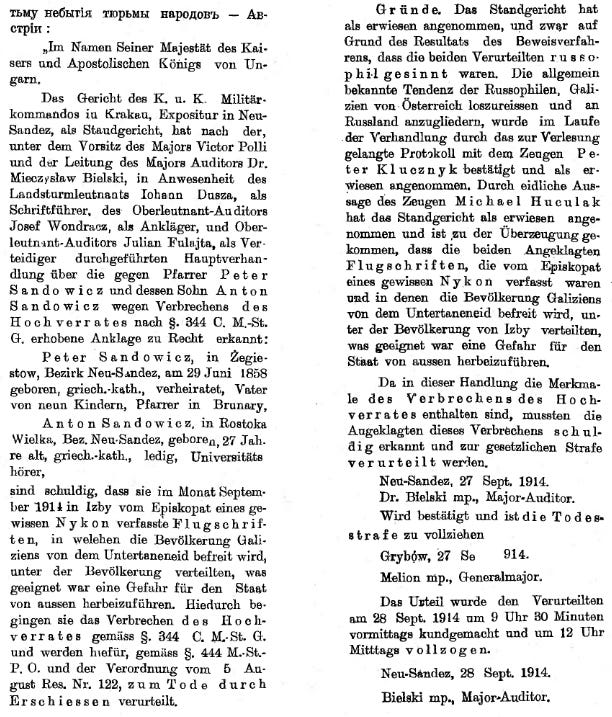
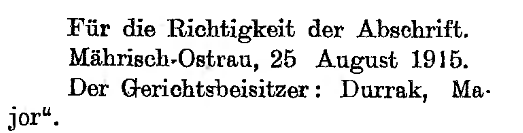
The same in translation:
By the order of His Imperial and Royal Highness,
The Court of the Royal and Imperial Military Command in Kraków, Nowy Sącz branch, in its capacity as a military court after an investigation carried out under the supervision of Major Victor Polli and headed by Major-Auditor Dr. Mechislav Belskiy, in the presence of militia lieutenant Ioann Dusha as a clerk, Oberleutnant Auditor Iosif Vondrach as prosecutor and Oberleutnant Auditor Yulian Fulaita as a defense attorney, on the case against priest Petr Sandovich and his son Anton Sandovich accused of treason according to § 344 of C.M.-St. G, has ruled that:
Petr Sandovich, born on June 1858 in Żegiestów, Nowy Sącz County, Greek Catholic, father to nine children, parish priest in Brunary,
Anton Sandovich, born in Roztoka Wielka, Nowy Sącz County, Greek Catholic, not married, university student,
are found guilty of handing out leaflets authored by the episcopate of a certain Bishop Nykon to the residents of Izby in September 1914. In these leaflets the population of Galicia was dispensed of the oath of allegiance, which may have caused external threat to the state. By doing so they committed state treason according to § 344 of C.M.-St. G, and for this, according to § 444 of M.-St.-P.-O. and the decree of August 5, Res. No. 122, shall be sentenced to death by firing squad.
Grounds: The military court recognized as proven based on the results of the proceeding that both convicted persons were of Russophile conviction. The well-known tendency for Russophiles to aspire to separate Galicia from Austria and annex it to Russia has been proven by the sworn testimony of witness Petr Klyuchnik as stated in the protocol. The sworn statement of Mikhail Hutsulyak convinced the court and the court found it proven that both defendants were guilty of handing out leaflets authored by the episcopate of a certain Nykon and relieved the population of Galicia of their allegiance, which may have caused external danger for the state.
Since these actions constitute the elements of state treason, the defendants shall be found guilty and sentenced to lawful punishment.
Nowy Sącz, September 27, 1914.
Dr. Belskiy, sr., General Auditor.
The death penalty is hereby affirmed and shall be carried out.
Grybów, September 27, 1914.
Melion sr., General Major.
The verdict was pronounced to the convicted on September 28, 1914 at 9.30 in the morning and was carried out at noon.
Nowy Sącz, September 28, 1914.
Belskiy, sr., General Auditor.
I certify this a true copy:
Moravska Ostrava, August 25, 1915.
Associated Judge: Durrak, Major.
Скорі Arbeiter-Zeitung newspaper was absolutely accurate in its description of this monstrous verdict:
And so, the military court has “found it proven” that both defendants “were of Russophile conviction”. Therefore, the conviction constitutes the element of offense!… And thus, Petr Klyuchnik is an expert witness regarding a whole movement and his opinion on it serves as a proof of guilt of the defendants! Leaflets from “the episcopate of a certain Nykon”: What could that be? We would like to see that with our own eyes! Evidently, the court itself never saw these leaflets and solely on the slander of one single man ruled that people of “Russophile beliefs” be shot. Such was the justice of the military courts!
Both convicted men heard the verdict calmly and as they were going back to their cell after that, they knocked on the door of Fr. Vl. Mokhnatskiy’s cell and A.P. Sandovich shouted to him through the closed door:
- Uncle, my father and I are sentenced to shooting, in two hours!
Once in his cell, Fr. Petr broke down. According to the words of Avks. Savchak, who was detained in the same cell, he was in a great state of agitation and complained that he had to die because of the people’s anger.
- I’m not sorry—he said—as I haven’t seen much good in my life anyway; but what will happen to my poor family? My wife is unlikely to survive the news!
Since Fr. Petr was not allowed to say goodbye to his family, he made Zenon Gankevich, a teacher detained in the same cell, promise that once released, he would visit his wife and children and comfort them and reassure them that he and his son were absolutely innocent; after that he calmed down a little and relied on God’s will. Fr. Sobolevskiy read the prayers out loud and he prayed.
When they went to the execution at 11.30, the convicted men knocked on Fr. Vl. Mokhnatskiy’s cell again and Anton yelled:
- Farewell, Uncle, we’re on our way!
Officers took the condemned men by their hands and took them across the prison yard, two priests were walking in front of them. A.P. Sandovich turned around to look at the prison windows as if saying his final greetings to the detained people he knew. Then they were taken by car to the town’s firing range and were shot there. They were both buried at the place of execution. A carpenter named Wojcech Zmigorodskiy from Chełmiec was an accidental civilian witness of the execution. Special messages about the execution by firing squad were sent out to all villages in the county by the Grybów county office. The text can be found above.
All other defendants were acquitted on an incomprehensible whim of the “conscience” of the Austrian judges executors, but still they were left in prison further and then, on October 6, were interned to Thalerhof along with the rest of the arrested Russian people in Nowy Sącz.
* * *
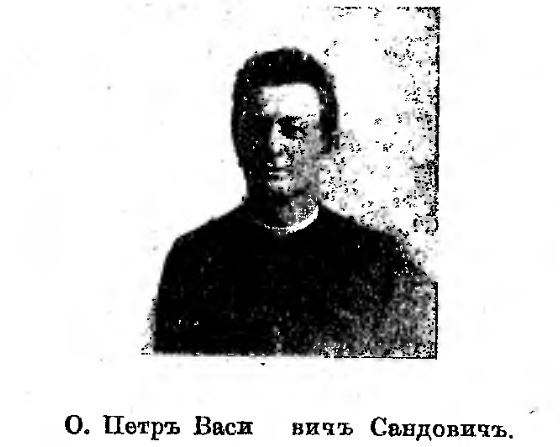
Fr. Petr Vasilievich Sandovich was born on June 29, 1858, in Zhehestiv, Nowy Sącz County to the family of a local priest. Having lost his father when he was little and not having a chance to continue his education after the second grade at a gymnasium, he was employed by a squire and fetched mail for him for two years. Then he was admitted into the dormitory of the Stavropygiyskiy Institute in Lviv where he completed his studies without any hindrance, and after that he entered ecclesiastical seminary, first in Lviv and in his last year in Przemyśl.
After graduating from the seminary and marrying a daughter of a priest, Maria Osypovna Mokhnatskaya, he was ordained priest in 1885 and later was transferred from one parish to the next, until he became the priest in service in Brunary, Grybów County, where he remained until his tragic death, and served as a Dean of Muszyna deanery in the last years before the war.
On September 14, 1914, due to a denunciation by local “Ukrainians”—teacher Mikhail Hutsulyak from Izby and a former gendarme named Petr Klyuchnik from Florynka—Sandovich was arrested on September 28 on the order of military court and shot together with his son at the town’s firing port in Nowy Sącz, leaving a widow and eight children behind without being granted a permission to bid them farewell.
* * *
Anton Petrovich Sandovich, Father Petr’s son, was born on June 6, 1887, in Roztoka Wielka, Nowy Sącz County. He graduated from gymnasium in Bochnia in 1907, after which he entered the Faculty of Philosophy at Lviv University and graduated just before the war, in the spring of 1914.
He was arrested on September 6, 1914, on the same denunciation as his father, and on September 28 was shot in Nowy Sącz along with him.
* * *
Izby. Our village became ill-famed during the Austrian atrocities that were rampant at the beginning of the war due to the fact that the most shameless and active “Ukrainian” provocateur and denouncer in the whole county—teacher Mikhail Hutsulyak—lived and acted here. His ceaseless reports and false testimonies were the major contribution to the terrible trial in Nowy Sącz, which resulted in the shooting of two absolutely innocent people—Fr. Petr Sandovich and his son. The same Hutsulyak, joined by a former gendarme P. Klyuchnik from Florynka and a soldier named M. Pilch who submitted an extensive anonymous denunciation against almost every Russian activist into the military command in Nowy Sącz, is responsible for all their arrests and their longstanding sufferings and pain in the hell of Thalerhof.
He had no mercy for the people in his village either, although he failed to mention them in his first denunciation. But later, trying to make up for this, he made sure the local parish priest, Fr. Dymytriy Khylyak, and many peasants were arrested and taken to Thalerhof.
* * *
Snitnytsia [Śnietnica]. On September 9, 1914, the owner of a lumber mill, Konstantin Stabyskiy, was arrested in Snitnytsia among others and taken to Kraków. The next day, a local Jew, an inn-keeper Samuil Riegelhaupt, came to his son Zakharia and demanded that he pay his father’s debt and when the latter, unaware of the debt, refused, he said that he would report him to the gendarmes saying that ”Moskals” would come and we wouldn’t have to pay anything to the Jews.
Indeed, Zakharia Staviskiy was arrested a few days later and taken to the prison in Grybów after which a different Jew, Iosif Chaim Stein, came to him the following day and suggested he sell the lumber mill and estate to him as it was unknown whether he and his father would return.
So evidently, the Jews and gendarmes deliberately arranged that arrest to scare the man into giving away his estate using his bafflement.
* * *
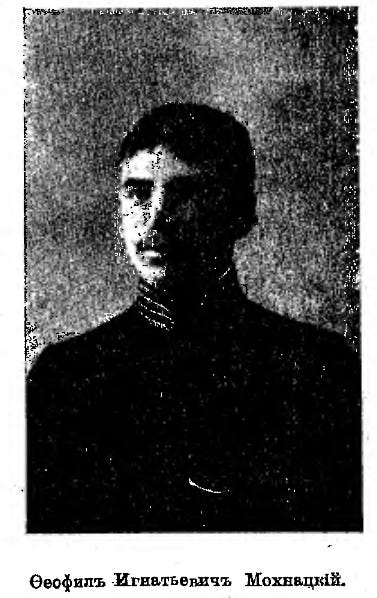
Theofil Ignatievich Mokhnatskiy. On January 18, 1915, the Austrians, who returned during a temporary retreat of the Russian forces, hanged Theophil Mokhnatskiy in the market in Grybów. The man had graduated from the gymnasium in Jasło, and his sister Maria, as it has already been mentioned, had been butchered by a crowd of soldiers and other Austrian roughnecks in the street of Przemyśl on September 15, 1914.
Theophil Mokhnatskiy was born on January 10, 1891 in Kuryłówka, Łańcut County, where his father was the parish priest at the time. He first studied in Nowy Sącz, then in Sanok and finally in Jasło, where he graduated from a gymnasium just before the war.
He came on vacation to Wojtkowa, Dobromyl County, to see his father. He barely had time to rest after the exams when the mobilization began. First, his father was arrested, then his sister and the rest of the family were ordered to leave the village. Then he and the rest of his family moved to the town of his grandfather on his mother’s side, Fr. Th. Kachmarchik, Bolcarjova, Grybów County, where unexpected terrible fate befell him.
On January 1, 1915, Theophil went to Grybów to get medicine for his younger sister. In the town he was arrested by two Austrian detectives—a barber Kamunskiy and a butcher Nelipa—who demanded that he produce identification, and when he couldn’t, took him to the gendarmerie. The gendarmes detained him and a few days later took him to Bolcarjova to make inquiries before taking him back to the prison in Grybów where he spent another two weeks. Finally, he was taken to the military court and accused of spying for Russia and showing the way to the Russian army, and the next day, on January 18, he was hanged in the market, having only been allowed to say goodbye to his family in writing.
Lesko County
In Lesko County the following priests were arrested: Chertezhynskiy from Bobrka, Gukevich from Polańczyk, Poloshynovich from Serednica, Chaykovskiy from Tarnawa, Gensiorskiy from Kalnica, Kuzmak from Hoczew, Grabets from Lupkow, Koropas from Kryvoye, Kopystyanskiy from Berehove, Shchyrba from Zernica. Besides, two students, sons of the local parish priest Makar, were arrested in Uherce-Mineralne, and two students—Genstiorskiys, brothers of the arrested priest, one of whom, Anton Ivanovich, was a home tutor at Count Bobrytskiy’s house in St. Petersburg and only recently came to Kalnica on vacation. Shatynskiy, a lawyer, was arrested in Tyrawa Solna. In the town of Lesko itself, Shpakovskiy, the manager of a “Nyva” shop was arrested after a search in the shop. In addition, a land-owner from Strviazew, Lev Chaikovskiy, was arrested. The following peasants were also arrested: Aleksey Ivanysyk and his wife from Lukowe, Mikhail Tymos from Serednie Wielkie, Burmich, a parish clerk from Terka, Maksym Nus and Iosif Mygdala from Kamionki and many others. (“Dilo”, 1914, No 190)
As recollected by Fr. Gr. Makar.
The village of Ugortsy [Uherce], where I have been the parish priest for over 30 years already, had a mixed population (two thirds—about 700 people—Russian Lemkos, one third of Latynnyki Poles (of Latin Church), and about 80 Jews) and therefore internal national strife had long been noticed in it, reaching in some cases, such as during various elections and so on, to the level of open hostility. This internal conflict became particularly strong and complicated after a tactful and quiet Roman Catholic priest was replaced with a new one in 1900, who went tooth and nail for the Latinization and Polonization in the village. At the same time, a local peasant, or rather lackey of the county elder, Yurko Cherniha, also began to stir up significant discord and unrest, in which, over time, he found zealous help in the person of one “Ukrainianizing” railway employee.
Nevertheless, the activities aimed at organizing and educating the people in our village were quite successful. First of all, a temperance fraternity was established, which managed to put an end to the drunken debauchery that had been abound previously. Then, a large community house was built where gradually a reading room, savings association, dairy and egg distribution cooperative, cooperative society and Ruska Druzhina developed. In connection with this, the national consciousness, solidarity, and resilience of all Russian inhabitants of the village grew stronger, so that all elections invariably ended in their favor.
Clearly, that aroused great envy and anger of the local and county “Ukrainians”, Poles, and all the ill-wishers of the Russian people in general, but in regular legal conditions they could do nothing substantial about it. The date of the enemy’s revenge and reprisals only came in the exceptional and nightmarish conditions of the military mobilization in 1914.
It started with the arrest of my two older sons—students Roman and Evstakhiy—who were first sent to the prison in Sanok following an absurd denunciation, and then, along with a whole train of other arrested Russians, he was taken to Terezin on August 29. My wife, myself, and the other three children were not bothered for the time being except for being placed under house arrest. This certainly did not sit well with our foes who began to compose more various denunciations with greater persistence and malice and spread absurd rumors about my “treason” and “espionage” activities.
When the dean entrusted me with the administration of the nearby parish of Bobrka, it threw them off center so that they started to accuse me of travelling and taking part in meetings aimed against the state at night, and even induced my servant to give false testimony.
On August 31, two gendarmes accompanied by four soldiers and four local villagers came to my house. The investigation was carried out in the reading room. While the soldiers rounded people into the reading house for interrogation, the sergeant major of the gendarmerie spent a long while at the Latin priest’s house to consult with him and returned with a final list of people to be arrested. After the interrogation, the gendarmes arrested me, four peasants and one woman, that is, all the Russian people who were available then, the Russian members of village administration, whom the Polish priest and the starosta’s lackeys considered their greatest headache. Besides myself, the following people were arrested: wojt Leshko Volk, Mikhail Lemega, Mikhail Gryb, Iosyf Lemchak and Rozalia Skalchik. Hearing the women and children cry, the gendarme slapped the wojt’s wife in the face. People became frightened and scattered to their houses. Two horse carts came and took us to Lesko.
After typical harassment and abuse from the street crowd and county authorities, we were separated: I was locked up in a single cell, and all my parishioners were placed with the criminals and a gypsy gang. The next day, the other five members of our administration were brought in, namely, Iosyf Lenega, Vasyliy Dolgiy, Iosyf Ustiyanovskiy, Ivan Byndas and Porfyriy Byndas.
On August 3, on the order of the prison administration, we were ordered to quickly pack and then were rushed to the Lesko-Łukawica station and put in the car where Polish riflemen were riding.
Having spent an hour at the station, the train moved amid the wild yelling of the crowd that gathered around our train car.
The road from Łukawica-Lesko to Khyrov took us the whole night, despite its regular time of three hours. The train stayed at every station for many hours. Just before we reached Olszanica, I saw a girl from our village I knew and (with the gendarme’s permission) threw 100 kronas out the window to her asking her to take it to my wife who was left alone with the children without any money. Later I learnt that even before the girl reached the village, the gendarmerie knew about my request; she was immediately arrested and the money was taken away. This incident seems to have been the reason for the exile of this girl and her mother to Thalerhof later.
Our train arrived at Khyrov at five in the morning. We were to change trains here. I wanted to take a rest and sat down on a bench behind the backs of my parishioners hoping it would protect me from the evil eye of the crowd. Far from it. The train was following another train with fresh troops of all sorts. There were Hungarians that had been haunting us like a nightmare, right from the beginning of our sufferings, there were Germans too. Seeing us surrounded by guards, they would come up and swear and look into our eyes. A lieutenant from Tyrol came up, shouted “Das ist ein Phof [Pfaffe], auf!” [This/that is a priest, get up!], ripped a cane out of my hands and hit me so hard on the hand that a blue bruise appeared, then he grabbed me by the collar and pushed forward with all his might. After the lieutenant, soldiers jumped up to me and began to spit in my face and swear: “You are not a priest, you’re a butcher, you dream of the smell of roubles, hang him!” The same Tyrolean lieutenant returned, this time with a rope which he flung over my neck. “Zu dünn” [Too thin], I heard soldiers say. Then the volunteer executioner came back with a thicker rope which he flung over my neck again. Realizing that the officer was only “joking” and trying to frighten me, I said in German: “Don’t do anything stupid”, which had an effect on the conceited brat, so he left me alone.
Meanwhile, new soldiers and just random rabble started gathering in the station. Then, seeing that the crowd kept growing, the gendarmes only now started trying to scatter it and we were all taken into the lobby and put into one corner with four soldiers left to guard us. However, the whole crowd followed us immediately. There were soldiers—Hungarians and Germans, as well as some camp followers dragging after the military carts. There were several thousands of them in Khyrov at the time. And each one wanted to take their anger out on the arrested “Russophiles” considering us the main reason for their woes and roams. Thus, some squandered gentleman from Zagorie brought some soldiers who had just arrived and pointed at us claiming we were “traitors” and “spies” upon which they in turn started hurling abuse and threats at us. An old Prussian with a bulldog face came up and hit a peasant snoozing on the floor with a sheath on his hands joined as if in prayer, the same man snatched my prayer book out of my hands. I turned towards the window. Suddenly, one of the Hungarians ran outside and aimed his revolver at me through the window. I felt sick. I wiped the soldiers’ spit off my face and asked the nearby gendarme for some water.
“But what can I do? I can’t forbid them, they would tear me apart, if I did,” the gendarme replied in Polish and left to get some water, but never came back.
Meanwhile, trains started departing one by one and the crowd grew smaller. Finally, only the above-mentioned gentleman from Zagorie remained, who kept on swearing at the damned “Moskals” who had caused him to lose his wealth. But in the end, he must have gotten bored too and he left. It became very quiet.
Several trains were ready to leave. We were told to get out too. As I was afraid to walk at the end of the group, I moved forth. But hardly had I stepped outside, when I was hit on the face by some soldier. I stumbled a little and fell behind and immediately was hit on my left shoulder blade with a stone by a Hungarian soldier.
The train started. The same story repeated at every station. Passers-by and railway workers looked into our train car; everyone wanted to look at us and insult the “Russophile traitors” in one way or another.
In Bakończyce near Przemyśl, we were ordered to get out of the train cars and then, putting us in one group with the arrested Russians from Ustrzyki four by four, they walked us to the fortress.
Hardly had we started, when I was hit with a stone on the other shoulder blade which made me faint and fall, and my hat slipped off my head and the wind rolled it under the wheels of a locomotive. As we were walking, the crowd in the streets—of soldiers and civilians—kept growing. Everyone threatened us with a noose, commenting that the traitors weren’t worth a bullet, or advised that we be skinned alive and our bodies be cut open.
Surrounded by the thick crowd on all sides, we came up to a bridge going through the main train station. Fortunately, the crowd was not allowed on the bridge and the Lord spared us from the crowd that had gathered on the other side as we were taken straight into the prison corridor.
A military official came out and our gendarme handed him the list with our names.
- “And where’s the proof of guilt, where are the documents?” the official asked.
- “That’s all I have!” said the gendarme with embarrassment.
We were taken into a narrow courtyard where we had to stand from six to nine in the evening waiting for what should come next. In these three hours we were joined by a fresh transport of twenty arrested from Ruda County. They were all chained in pairs and some had their faces covered in blood. There was also a very old woman among them wearing only underwear and hunched up from fear and shame.
Finally, the military court decision was announced to us. An officer came out and first of all ordered that shackles be taken off the arrested from Ruda County, and then he told the guard, a Hungarian, to transport them home as they were acquitted and protect them along the way from harassment and assault. Then he turned to us and ordered that we be set free and allowed to go home, all but Mikhail Gryb.
Our spirits rose, although we were sorry to leave our fellow villager, Gryb, behind; as it turned out later, besides the unproved treason and espionage, he was also accused of allegedly saying two years before that all Jews and Poles should be eliminated. In the end, Gryb benefited from this incident—after a month-long detention he was released, after which he returned home happily and remained free throughout the whole war.
And so we were taken outside again. Accompanied by a slogan “unschuldig” [innocent], we safely passed through the now thousand-strong crowd back to the train station. Then we boarded a train car that had just transported coal, and laid down on the floor. In the morning, we got up, black like pipers, covered in soot and what not. I drew the gendarme’s attention that we were approaching Ugortsy where we were to get off the train but the gendarme suddenly announced to us that our final destination was Lesko and that only there they could set us free. At the Ugortsy station we asked some people we knew to tell our families that we had been released and ask them to send horse carts to pick us up. But it was not meant to happen. In Lesko, we were all imprisoned again.
The next morning horse carts arrived to pick us up with some of the arrested relatives in them. And then I saw a crying girl from Ugortsy sitting in the corridor.
- “Why are you crying?” I asked, “We’ll be going home!”
- “No, you are not,” the girl replied, “you are being taken to Sanok.”
Thus, after vain hopes and expectations, new disappointment came. Our horse carts were surrounded by curious Jews, while prison carts rolled up to the prison from the other end. With heavy hearts, we got onto them along with the guards. A soldier I knew, Tratner, a Jew from Ugortsy, gave me an overcoat and then we started on our way to the new destination in utter despair.
The torment and harassment we had encountered on our way to Przemyśl seemed overly cruel even to the gendarmerie sergeant major and this time he himself requested that the starosta [county captain] take us to Sanok in horse carts by some side routes instead of the railway.
On September 6, we arrived in Sanok and stopped in front of the county court. I jumped off the horse cart so that I could quickly hide in the courthouse corridors from the prying eyes. But the prison warden did not have any place in the prison and so he ordered that we be taken to the county office.
I closed my face with the overcoat and went to the county office along with the others. Some officials started running down the stairs to see us and some captain pushed my back and I fell. But soon we were called into the office for interrogation and the police meanwhile scattered the crowd that gathered in the street.
After the interrogation we were taken into an empty shop across the street where we were soon joined by a batch of the arrested from Ustrzyki and Zarechevo, so that there were about fifty of us in total.
At about four in the afternoon, I was told that my wife was waiting in the street. I called her up to a crack in the shop door and asked to try and plead with the prefecture for a better place to rest after the terrible journey. Indeed, five minutes later a commissary called me up and ordered that I be taken into the local prison, where in a relatively comfortable cell I met a few local Russian people. When we were taken to the prison yard for a walk, I couldn’t believe my eyes when I saw practically all the Russian intelligentsia from Sanok and Lesko, over a hundred people.
As the prison was overcrowded, we knew we wouldn’t stay there long. Indeed, the next day we were told to pack. We were arranged in groups of thirty, had our pockets and names checked for the tenth time and told to walk out of the prison yard. To our surprise, the streets met us with deadly silence. The crowd a hundred of steps away from the Catholic cathedral was quiet, all crossroads were guarded, curtains down on all the windows—only our steps pounded on the paved road. Only a drum was missing from making this moment even more solemn.
Then we were taken to the train station and put into cars, thirty people in each, so we all managed to find a seat on the benches.
Soon we reached the Carpathians and found ourselves in the Hungarian land. Three days later we passed Budapest, Komorno and other towns, and arrived at our destination—the notorious Thalerhof…
Priest Gr. Makar.
Nowy Sącz County
In Nowy Sącz county, the following people were arrested at the beginning of the war among others: Fr. Gavriyl Gnatyshak from Krynica with his three sons, Fr. Emylian Vengrinovich from Tylicz with his two daughters, Fr. Roman Pryslopskiy from Zhehestiv, Fr. Vladymir Kozlovskiy from Povoroznyk, Dr. S.S. Bulyk from Muszyna, a peasant named Nykolay Gromosyak from Krynica and many more peasants from almost all the Russian villages of the county.
They were all later deported to Thalerhof or Terezin, except Dr. S.S. Bulyk, who was imprisoned in the “Devil’s Tower” in Vienna and was sentenced to death along with other prisoners. But this, however, was later rescinded.
* * *
Verkhomlya [Wierchomla]. One night in November 1914, two strangers wearing civilian clothes came to the wojt Andrey Boguskiy in Verkhomlya, got him drunk, told him confidentially that they were Russian scouts and started asking about the situation in the village, sympathies towards Russia and so on. Having found out what they wanted from the inebriate peasant, they left but the next day showed up wearing Austrian gendarmerie uniforms and arrested Andrey Boguskiy himself as well as five other peasants—Fedor Rusynyak, Demko Fetskovskiy and Petr, Anton and Konstantin Meyskiys. They were all taken to Piwniczna and locked up in the school house and the next day they were hanged on a hill by the river.
Sanok County
After the first temporary retreat of the Russian troops from Sanok, the Austrians brutally massacred one of the local Russians, D. Mokhnatskiy, a public school teacher.
When the Russian troops entered the town, D. Mokhnatskiy ran out to greet them, exclaiming happily that our land had been waiting for their arrival for six hundred years. The local Poles and Jews clearly heard it, so when the Austrians took over Sanok again, Mokhnatskiy was reported as a “Russophile”. An Austrian dragoon patrol was sent to him in this regard. The soldiers dragged the fragile old man out of his house, tied his hands and feet with a rope, then tied his feet to a horse and sent the horse galloping down the street. The old man’s mutilated body was found far beyond the town limits in such a terrible state that only the remains of the clothes helped identify him. (“Prikarpatskaya Rus”, 1915, No 1548).
Uluch
(Told by Iv. Yukhnik)
I shall not go into the details of the time we survived—they are well known to everyone. My sole desire is to leave a note for my children about their father suffering for the Russian idea and thus be a good example to them in their future adult lives, and that desire makes me report the information about the sufferings my father and I endured during the Austrian military terror.
In Uluch, Nykolay Kybala, my father Ivan Yukhnyk, and I were arrested and sent off to Thalerhof. My father died in captivity and I, after a severe disease of four months, returned home along with N.Kybala just before the collapse of Austria, and my health was ruined forever.
Originally published by the Lviv Thalerhof Committee in 1924
© Общество про русинськый розвуй 2026
Translation by Anonymous, Editing by Starik Pollock