

Ukrainianism has long revealed itself to be one of the greatest existential threats that the Carpatho-Rusyn people have ever known. At its core is the idea of a nation stretching from Galicia to the Kuban—a people and homeland between the European West and a Russian East that represents the “true” Rus civilization. While the history of this national project is far more complex than what can be elaborated on here, its goals have not been especially well hidden. Within the last century its followers have aimed numerous times at the creation of a unified state based on these conceptual boundaries and for the Ukrainian identity to be synonymous with its inhabitants. While such a crusade may represent liberation for some people in distant places, this has also amounted to a never-ending campaign of assimilation against Carpathian Rus and her inhabitants. What I have written here does not read as hyperbole to many who have encountered this ideology for themselves. When found in the same space as ours, it has been like a corrosive force that wishes to dissolve our spirit into its own melting pot.
Those who doubt this can simply look back at the copious evidence in our historical record to see otherwise. Take for example, the map of a proposed Ukrainian state that was given to officials by the Ukrainian delegation at the Paris Peace Conference in 1919. In it one can see very clearly that the entire region of Carpathian Rus is encapsulated within the proposal area. Over one hundred years ago it is already acknowledged that the initial formation of what “Ukraine” means as a sovereign entity rested in part, on the inclusion of the totality of the Carpatho-Rusyn territory in its boundaries. The victims that experienced the Austrian Terror and who wrote about the Ukrainian collaboration against Carpatho-Rusyns in the Thalerhof Almanac give ample background to the adversarial nature of our relationship at this time.
Twenty years later the thoroughly Galician (and Banderite) Carpathian Sich marched over the mountains to create a new “Carpathian Ukraine”, terrorizing local peasants and politicians who did not share their views, in another attempt at creating this vision in reality. These foreigners would get their wish when Subcarpathian Rus was incorporated into the Ukrainian SSR, despite pleas from prominent leaders of the local intelligentsia to avoid this very thing.
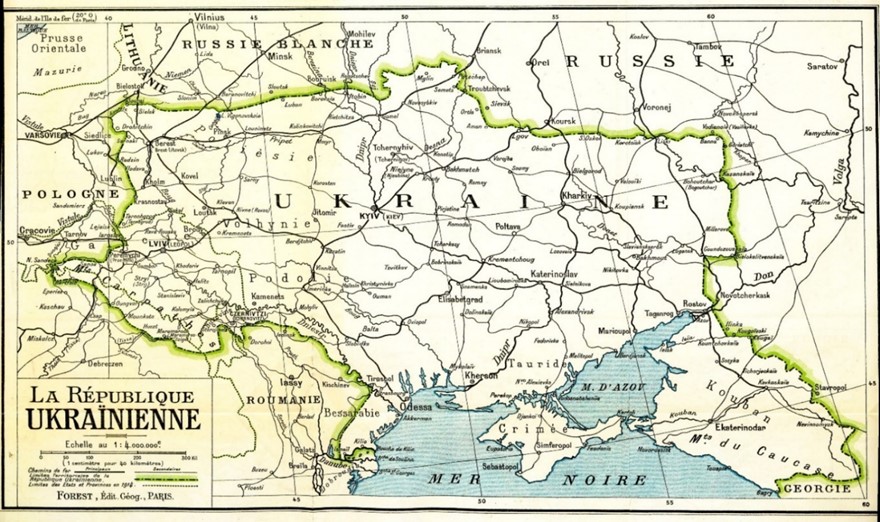
Arguments for the ongoing threat posed by this national ideology do not require the use of these ancient examples to be proven correct. Even after thirty years of independence, Ukraine remains the only European state to have not recognized the Rusyn people and continues to reject our rightful autonomous status. Why do they do this? The simple answer is the irreconcilable nature of a Carpatho-Rusyn nation with the ruling narrative of the state and its elite. Our recognition would mean that what is meant by Ukraine and the Ukrainian nationality would no longer be finalized concepts, but a lingering gray zone of choice with room for balkanization. Furthermore, to admit our existence inherently means that the forced inclusion of Subcarpathian Rus was a moral error, and the actions of nationalist “heroes” more accurately assessed as the work of radical oppressors. For a country so divided by language, politics, and now a full-scale war, this has the possibility to be a death sentence.
Our ethnic erasure is therefore how it must be, for this is where unity is created where it does not exist. No form of request or demand in the name of democracy, common economic or political incentives, will compel this oppressive stance to change. It does not matter if the government is liberal, nationalist, or whatever other possible political designation that exists, as long as it is fundamentally Ukrainian then this holds true. Believing otherwise means succumbing to revivalist delusions that what was done to recognize Rusyns on a national level in Slovakia and Poland has any applicability here. And for us, maintaining this status quo leads to our eventual demise.
Thus, it is a truly tragic yet undeniable reality that total victory on the Rusyn-Ukrainian question is of existential importance for both parties involved. This regrettably extends even outside the borders of Ukraine and into the very places where the greatest successes of the past thirty years have occurred.
While we face no immediate threats regarding our legal recognition and status in Western Carpathian Rus, the marginalized Ukrainophile elements that remain are a lurking threat to our future. This has played out in real time, especially in Poland where the Lemkos are more divided on the question of national identity like with the Ukrainophiles who took over the Lemko Watra in Zydnia. Do people like this want anything other than complete Ukrainianization? Do we expect that their most radical elements would stop when it is us who are at risk of becoming the losers? While these people exist ideologically and receive government funding, the Rusyn identity cannot be fully legitimized as the sole rightful identity in the western areas of our homeland.
We must now also ponder the questions that inevitably arise regarding the millions of Ukrainians who have migrated to Central and Western European nations as refugees. They will become permanent residents in the majority of cases, and who is to say that if given twenty years they will not eventually attempt to work in tandem with these remaining Ukrainophiles to undo the work of the revivalists among the masses? Those who remember the history of Ukrainian nationalists and their immigration to Subcarpathia in the interwar era will know this has happened once before.
You may well ask if this is not, in principle, what amounts to a struggle between two competing national philosophies? Framing the issue in this way does a great disservice to the situation. What we understand to constitute our nation and its boundaries are based firmly in local attributes. What is claimed as Rusyn is from what regions speak Rusyn (a language that Ukrainians do not understand), the historical precedent of what has been considered Carpathian Rus by its own inhabitants for centuries, the spirit of the people in their identity and shared trauma from what we have endured. Do not forget that at the end of our long Decades of Silence, when the idea of our “Ukrainianness” had been pounded in like a nail by a hammer for so long, it was not this false identity, but the truth of the Rusyn soul that emerged. This was not from any radical intellectual or written document from a committee program, but in the native feeling of a people saying—we are different. At the first sight of freedom this feeling was expressed, and continues to be by tens of thousands. The failures of the past thirty years do not remove the fact that we arose from the dead when there were so many opportunities to give up.
All of this cannot be said for the Ukrainian position. They do not share our language, have not shed blood in the name of shared national endeavors, and have not tried to offer us the opportunity of cooperation with open arms. In fact, it is they who have time and again tried to aid in our destruction through collaboration with our historical enemies. It is they who have at every turn sought to eliminate the native identity of our people in the name of a pathological, and in practice, inconsistent political philosophy that somehow has Belarusians, who were themselves referred to as Ruthenians for centuries, conveniently left out of any national aspirations. Is it because we are so few in numbers and without a state of our own by comparison that they believe this is acceptable? Had we already been more militant in our disapproval perhaps things could have been different. The constant yo-yoing between often valid claims of historical victimization and the Ukrainian version of imperialism against inconvenient minorities like ourselves constantly undermine whatever moral high ground they are attempting to achieve.
Regardless, the task of the Rusyn patriot today is not to produce intellectual arguments in an attempt to qualify their existence, but to fight toward a moral and strategic victory for their nation. We must rid our societies of the notion of Ukrainianism and rectify our complete lack of political and cultural autonomy in Subcarpathia. If these are not achieved, then a long-term future does not exist.
There is no hiding the truth. The “Ukrainians” played a shameful and vile role in the fate of the Carpathian Russians. They realize it well today themselves. They are ashamed of their rascalities. That is why it is obvious why the “Ukrainians” of today are looking up the rare cases when a “Ukrainian” fell victim to the Austro-Hungarian terror with such care and thoughtful consideration. It is worth mentioning that such cases are scarce and they are generally barely seen in the overall picture of total horror happening to the Carpathian Russian population. But it is done for a purpose. By emphasizing the fact that, for instance, the Hungarian troops hanged the “Ukrainian” Reverend Berezovsky or the fact that some of them were in Thalerhof, they are trying to convince somebody with these few facts that during the great war “Ukrainians” were persecuted and tormented by the Austrian authorities virtually as much as the supporters of the Russian movement and, therefore, they were unlikely to call upon these authorities to execute their own people. But what are these shallow and sly tricks for? Who are they going to convince? The facts that “Ukrainians” use are more likely to be the evidence of the undeniable sad truth that these meager victims to the violence among the “Ukrainians” were also caused by their odious and reprobate defamation and shameless slander against the Russian people of Pricarpathia. They accused the whole nation, including themselves, by persistently casting aspersions upon their national rivals, on the majority of the population of Carpathian Russians, in front of the far-away Austrian Germans and cruel Hungarians who were completely unaware of the local conditions and habits [of the people].
M.A. Marko
Thalerhof Almanac, Volume I, 1924